Bud Farm: Idle Tycoon
- 4.7
- Rating
- 5.00M
- Installs
- Free
- Price

 Analysis by App-foxy
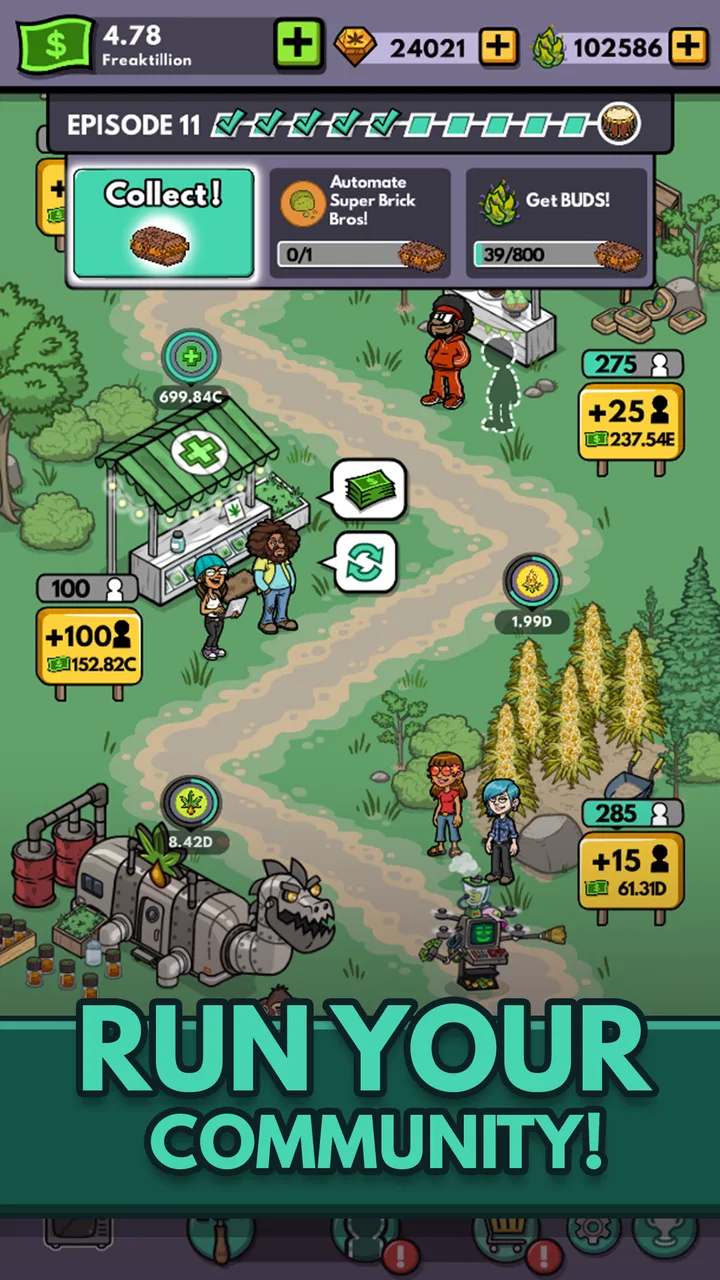
I spent time with Bud Farm: Idle Tycoon as a casual simulation game, and its main appeal became clear quickly: it turns a small cannabis-growing operation into a chain of taps, upgrades, and waiting periods. You plant, improve the farm, collect earnings, and decide where the next bit of progress should go. It is easy to understand, but the real question is whether the steady idle rhythm feels satisfying enough to keep you returning.
The game comes from LDRLY Games and is free to download and play. That makes the first step straightforward: you can try the core experience without paying an entry fee. The store also lists in-app purchases ranging from $0.99 to $199.99 per item, so the free access should not be confused with a completely purchase-free experience. I would approach it as a game you can sample at no cost, then decide whether its optional spending model suits your habits.
Its mature 17+ rating is important context rather than a minor label. The theme is built around growing and selling cannabis, so this is not a family-friendly farm game in the style of a cheerful crop-and-animal simulator. If you want a conventional agricultural setting, the subject matter alone may make this a poor fit. If you are comfortable with its fictionalized weed-farm premise, the management loop is much more approachable than the theme might suggest.
You May Also Like

 Blood Strike: 2.5 Anniversary
Blood Strike’s Loadouts Turn Every Drop Into a Tactical Gamble
A close look at Blood Strike’s custom loadouts: how fast access to signature weapons reshapes its battle royale rhythm, rewards preparation, and narrows the gap between fights.

 Pandora - Music & Podcasts
Pandora’s Music Is Easy to Start, but Harder to Recover
Pandora’s strength is its low-effort path from a seed to a station. Its weak spot is how much confidence it asks you to place in connection, setup, and quiet recovery.

 8 Ball Pool
 Is Built on Rivalries, Rematches, and Routine
A close look at the rivalries, rematches, shared routines, and unanswered safety questions that turn a quick pool match into a persistent mobile community.

 Samsung Music
’s Quiet Strength Is Playing What You Already Own
Its reach comes less from spectacle than from dependable access to a personal library. That simplicity is both the app’s strongest retention engine and its ceiling.

 AccuWeather: Weather Radar
AccuWeather Review: A Quick, Clear Forecast for Everyday Decisions
For everyday plans, the best forecast is the one you can understand quickly. AccuWeather makes rain timing, radar, and local conditions easy to act on, with a few trade-offs.

 Hill Climb Racing
Why Hill Climb Racing Still Turns Crashes Into One More Run
A tiny car, a bumpy hill and one more upgrade: Hill Climb Racing keeps resurfacing because its simple chaos makes every near-miss feel personal.
More From Our News Desk



How the idle farm loop works in everyday play
I find the idle loop easiest to enjoy when I treat each visit as a small planning session: collect, compare the available upgrades, and choose one goal before leaving the farm to run in the background. That keeps the routine from turning into aimless tapping and makes short check-ins feel intentional. It also sets up the bigger question of whether the game’s gradual progress feels fair without spending.
A business simulator designed for short visits
The best way to understand the game is to picture it as a routine rather than a long, uninterrupted session. I open it, collect what has accumulated, check which improvement is affordable, and set the operation up for the next period away from the phone. That structure suits small gaps in the day: a commute break, a few minutes after lunch, or a quick check before bed.
The tapping is useful at the beginning because it gives progress an immediate, hands-on feel. You are not simply watching a number rise. Each interaction helps establish the idea that the farm can become more productive, while upgrades gradually shift the focus from manual attention toward automation. That transition is the central satisfaction of the game: turning a modest operation into something that keeps moving while you are elsewhere.
There is a practical trade-off in that design. Idle games are rarely about discovering a completely new strategy every few minutes. They are about recognizing the best moment to collect, upgrade, and wait. If you enjoy optimizing a repeating cycle, the calm pace can be relaxing. If you need constant action, detailed construction, or a story that pushes you forward, the loop may feel thin.
Why upgrade decisions matter more than tapping speed
New players can easily focus on tapping because it is the most visible action. In my experience, the more useful habit is to treat every upgrade as part of a timing plan. Before spending, I consider whether the improvement will help during the next short session or whether it makes more sense to save for a larger step. That simple pause prevents the game from becoming a string of automatic purchases.
A good routine is to collect first, inspect the available improvements, and then decide whether your goal is faster immediate income or stronger progress while offline. This is one of the less obvious ways to get more from the game: do not spend simply because an upgrade button is glowing. Idle systems reward planning around return visits, especially when you know you will not be checking the farm for several hours.
I also found that the game works better when I give each session a purpose. One visit can be about building short-term momentum; another can be about saving toward a more meaningful improvement. Without that small objective, the actions can blur together. With it, the same compact loop feels more like running a tiny business than repeatedly pressing the same screen element.
The difference between active and idle progress
The game’s identity sits between an active tapper and a traditional management simulator. Tapping gives you something to do immediately, while the idle side lets the farm continue as a background project. That combination is convenient for players who want progress without committing to a full gaming session, but it also means the most rewarding moments are often separated by waiting.
For an everyday scenario, imagine checking in during a busy workday. You collect the accumulated output, use it to improve one part of the operation, and leave again. The session may last only a few minutes, yet it still feels productive because the previous wait mattered. Later, you return to see whether the new investment changed the pace. This makes the game a better companion for intermittent play than for a single long evening.
The downside is that waiting can become the dominant activity once the early novelty fades. If a player dislikes timers, incremental gains, or returning to the same management screen, the idle format will not be rescued by the theme. The cannabis setting gives the presentation its identity, but the underlying rhythm remains a patient, repetitive one.
What the free starting point means for value
Because the game is free, I judge its value first by how well it lets a curious player understand the loop before spending anything. That is a fair arrangement for this genre: download it, see whether collecting and upgrading feels good, and stop if the repetition is not for you. There is no need to treat a purchase as part of the basic decision to try it.
At the same time, the listed purchase range is broad, from $0.99 to $199.99 per item. I would not describe the game as offering unlimited value simply because its download costs nothing. The sensible approach is to enjoy the free path first and regard spending as optional convenience or acceleration, not as a requirement for deciding whether the game belongs on your phone.
This distinction matters particularly for idle games. A purchase can make progress feel quicker, but quicker progress is not automatically better value if the main pleasure comes from watching a long-term operation develop. I would only consider paying after identifying a specific frustration, such as wanting to reduce a wait, rather than buying impulsively because the next upgrade is expensive.
Where the game feels strongest
The clearest strength is accessibility. The basic fantasy is easy to grasp, and the tap-build-upgrade structure does not demand a tutorial-heavy commitment before you can begin. The mature theme gives the farm a different personality from ordinary agricultural simulators, while the idle format makes it suitable for players who prefer light management over demanding controls.
It also has a useful sense of scale. Starting with a small operation and gradually improving it creates a visible reason to return. Even when the individual actions are simple, the larger arc gives them context. I like that the game encourages me to think in terms of the next milestone instead of requiring constant precision.
Its reception suggests that the formula has found a substantial audience: the game holds a 4.7 average from around 199 thousand ratings, with over 5 million installs. Those figures do not guarantee that every player will enjoy the pacing, but they do indicate that the combination of idle progression and its unusual farm theme has broad appeal.
Where the experience can lose momentum
The same simplicity that makes the game approachable can make it repetitive. Once the basic routine is familiar, the excitement depends heavily on whether the next upgrade feels close enough to motivate another visit. Players looking for deep economic simulation may find that the decisions are lighter than the word “tycoon” suggests.
I would also be cautious about the psychological pull of incremental progress. The game is built to make a small improvement feel worthwhile, and that can encourage frequent checking even when the session itself is not especially varied. Setting a personal limit on play time or spending is sensible, particularly because optional purchases can reach a high price point.
Another limitation is thematic rather than mechanical. The premise will not appeal to everyone, and some players may prefer a neutral city builder, restaurant manager, or conventional farming game. Those alternatives are better choices if you want a setting that can be shared comfortably with younger players or a simulation centered on familiar agriculture.
Who will get the most from it
I would recommend this game to someone who likes idle progression but wants a more distinctive setting than another generic fantasy kingdom. It suits players who enjoy checking in several times a day, making small upgrade choices, and watching a virtual business grow without needing constant concentration.
It is also a reasonable choice for people who prefer free-to-start games and want to test the loop before considering optional purchases. The right mindset is important: treat the free version as the trial and the paid items as a separate decision. If the unhurried progression already feels enjoyable, you have found a sustainable reason to continue. If it feels like a chore, spending will not fix the underlying mismatch.
I would skip it if you want a detailed farming simulation with realistic crop management, complex markets, or hands-on control over every stage of production. I would also skip it if the mature cannabis theme is uncomfortable for you, or if you dislike games that rely on waiting and repeated collection. A more traditional farm builder or a deeper strategy title would serve those preferences better.
Device and version considerations
The game supports devices running Android 7.0 or later, which covers a wide range of compatible Android phones and tablets. The current version is 1.29.1, so I would check that your device meets the operating-system requirement before trying to install it. On a supported device, the main consideration is less about technical complexity and more about whether you enjoy the game’s compact, repeatable sessions.
The title was released on March 26, 2019, and its continued presence alongside its large install base makes it feel like an established idle game rather than a brand-new experiment. That is useful for someone who prefers a known formula, though it also means the experience is best judged on its mature core loop rather than on the promise of novelty.
My recommendation after weighing the cost
For me, Bud Farm: Idle Tycoon is worth trying because the entry price is free and the concept is immediately understandable. I would not promise that everyone should keep it installed, though. Its value depends on enjoying gradual progress, short return visits, and a mature fictional business theme. The game is at its best when I let it occupy a small corner of my day instead of expecting it to provide a full, constantly changing adventure.
The purchase range means I would keep spending firmly optional. Start without buying anything, learn how quickly the normal loop holds your attention, and decide only after you know whether you want convenience or simply more time with the free progression. That approach protects the main advantage of the game: it gives you a low-risk way to test a particular style of simulation.
My final verdict is a cautious recommendation for idle-game fans, especially those bored by standard farms and looking for a cheekier theme. I would choose it over a conventional farm title when I want quick check-ins and incremental business growth. I would choose something else when I want deep management, active gameplay, or a family-friendly setting. The free starting point makes it easy to sample, but the real value comes only if the waiting-and-upgrading rhythm genuinely fits your daily habits.
FAQs for Bud Farm: Idle Tycoon
01What is Bud Farm: Idle Tycoon?
Bud Farm: Idle Tycoon is a casual idle-management game in which you build and expand a cannabis-themed farm. You grow different plants, unlock production areas, hire workers, improve facilities, and sell products to earn virtual currency. Progress continues while you are away, making it suitable for players who enjoy relaxed tycoon games with regular upgrades and short play sessions.
02How does progression work in Bud Farm: Idle Tycoon?
Progress is based on improving your farm and production chain step by step. You collect earnings, upgrade growing stations, increase worker efficiency, unlock new locations, and reinvest profits into faster production. The game also includes objectives and events that provide additional rewards. Although idle income helps, returning regularly and choosing upgrades carefully can make advancement noticeably faster.
03Can Bud Farm: Idle Tycoon be played offline?
Some basic gameplay may remain accessible without a constant connection, particularly collecting or managing certain parts of your farm. However, an internet connection is generally recommended for the complete experience. Online access may be needed for advertisements, cloud-related features, special events, purchases, updates, and synchronization. Availability can vary depending on the version and device, so offline play should not be assumed for every feature.
04Does Bud Farm: Idle Tycoon contain advertisements or in-app purchases?
Yes, Bud Farm: Idle Tycoon uses optional in-app purchases and advertising as part of its free-to-play model. Advertisements may offer useful bonuses such as extra income, temporary boosts, or faster progress, while purchases can provide premium currency or convenience items. You can play without spending money, but progress may feel slower if you skip optional boosts and paid upgrades.
05Is Bud Farm: Idle Tycoon suitable for children?
Bud Farm: Idle Tycoon has a colorful, cartoon-style presentation and simple management mechanics, but its theme is based on cannabis cultivation and related products. Because of that subject matter, it may not be appropriate for young children, even though the gameplay is fictional and non-realistic. Parents should check the store rating, content description, advertising, and device purchase settings before allowing access.
Pros
- Relaxed idle gameplay works well for short
- casual sessions.
- Many upgrades provide a clear sense of progression.
- Offline earnings let your farm continue producing while away.
- Colorful graphics and humorous characters create a friendly atmosphere.
- Simple controls make it easy for new players to understand.]
- contras:[
- Progress can slow considerably without frequent upgrades.
- The amount of advertising may feel intrusive during longer sessions.
- Some premium items can make advancement feel pay-to-win.
- Repetitive harvesting and upgrading may reduce long-term variety.
- The game requires an internet connection for several features.
Cons
- Progress can slow considerably without frequent upgrades.
- The amount of advertising may feel intrusive during longer sessions.
- Some premium items can make advancement feel pay-to-win.
- Repetitive harvesting and upgrading may reduce long-term variety.
- The game requires an internet connection for several features.

Bud Farm: Idle Tycoon
Gallery